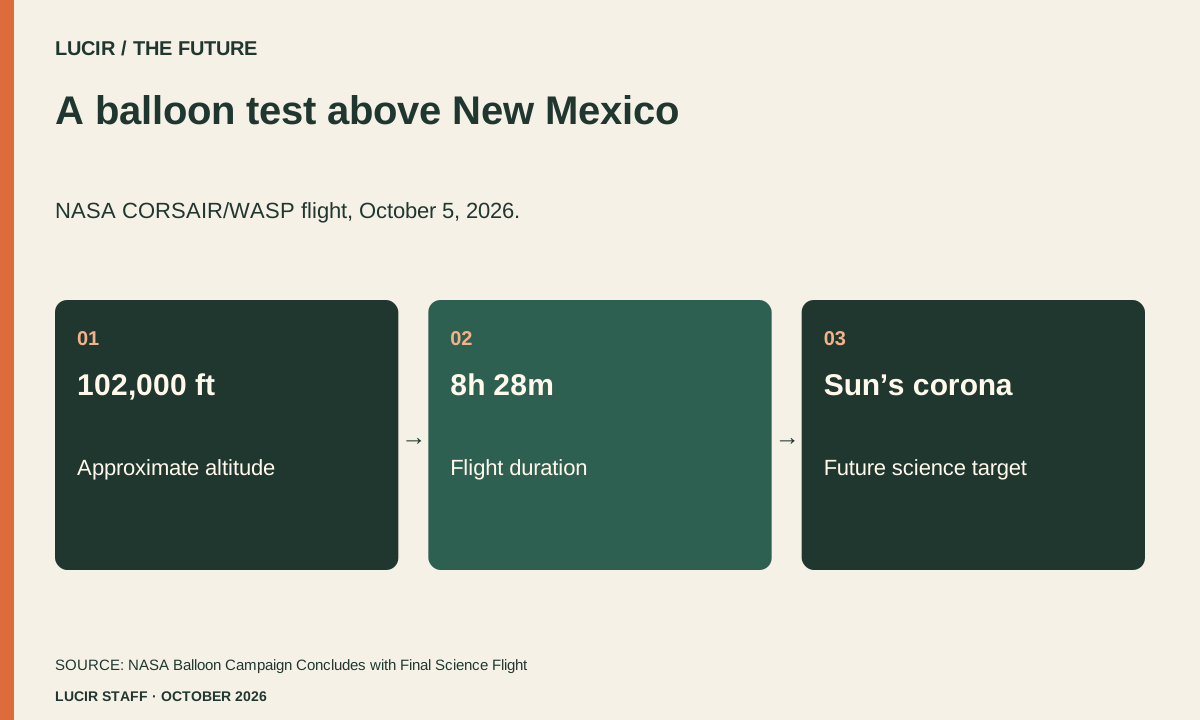
NASA's fall scientific-balloon campaign ended with an Oct. 5 flight of CORSAIR/WASP from Fort Sumner, New Mexico. The balloon reached about 102,000 feet and stayed aloft for 8 hours and 28 minutes. CORSAIR is a new payload intended to study the Sun's corona; WASP, the pointing platform beneath it, helps hold instruments on target while the balloon moves. NASA described this flight as a demonstration for a possible future Antarctic mission that would watch the Sun over roughly one solar rotation, at least 27 days. That longer campaign remains a possibility, not an approved flight described in the release. Balloon platforms let researchers carry instruments above much of the atmosphere, but this test was a technology demonstration rather than the full solar observation.
NASA's latest balloon flight tests a way to study the Sun
The CORSAIR/WASP payload flew for more than eight hours from New Mexico, demonstrating a precision-pointing platform for solar observations.
Source published 2026-10-06 · Updated October 22, 2026