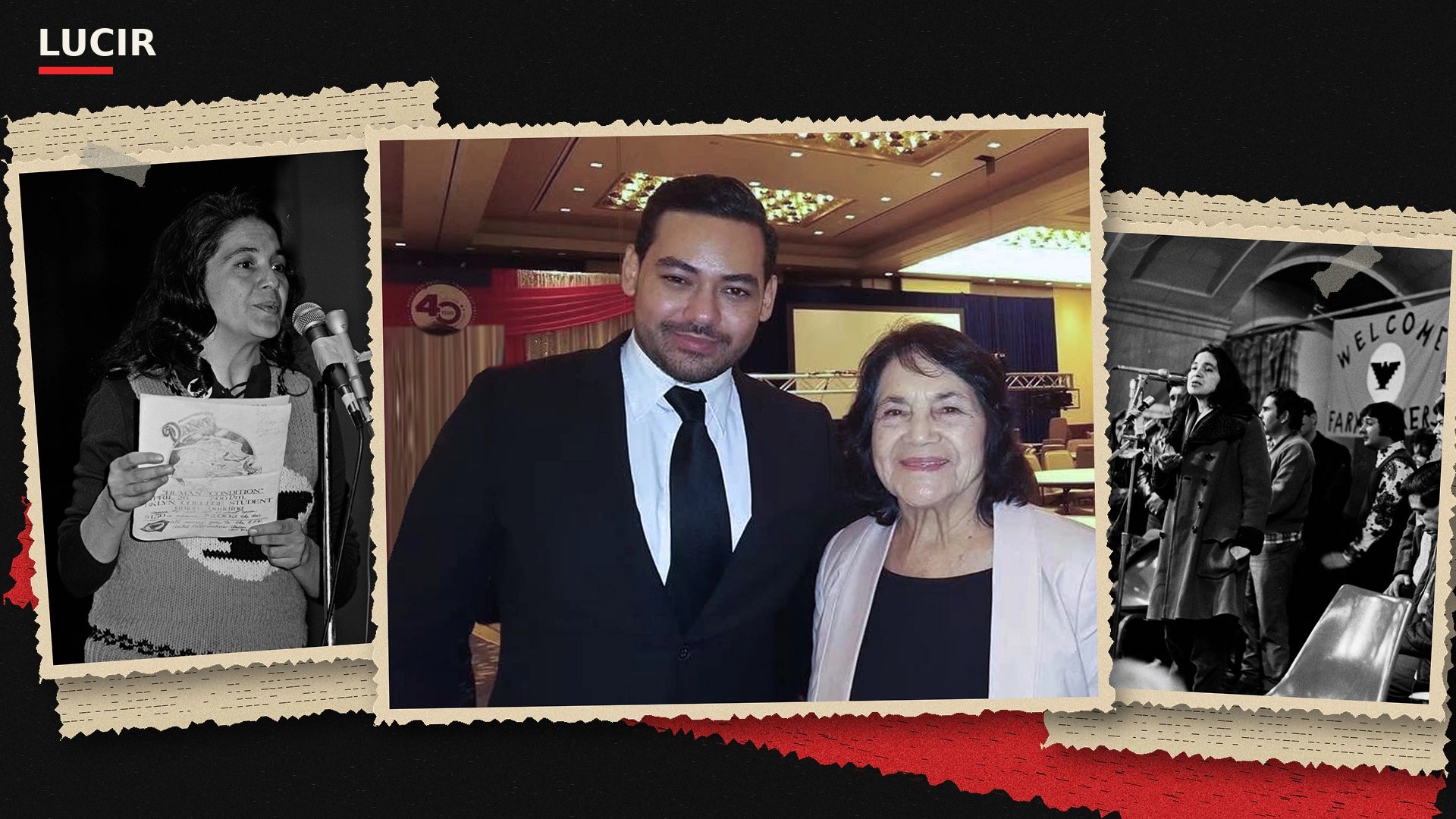


I met Dolores Huerta before I knew who Dolores Huerta was.
Earlier in my career, I was getting invited to galas and events in Washington, D.C. I am an alumnus of the National Hispanic Foundation for the Arts, and one of its afterparties brought us to Cuba Libre, a restaurant and gathering place for Latino artists and advocates. Félix Sánchez, co-founder of the National Hispanic Foundation for the Arts, arrived with Dolores and introduced me to her as a great Latino writer.
She was very nice to me. I had no idea whose company I was in.
I looked her up immediately. Here was someone introducing me as a writer worth knowing, and I did not know the woman standing in front of me. That required some humility.
If I was going to take myself seriously as a social and cultural critic, examining how power shapes our lives and how our stories get told, I had homework to do. I needed to know our heroes. I needed to understand the pillars, the shoulders I was standing on, the people whose work had helped make room for someone like me.
Being Latino did not give me that knowledge automatically. Neither did being invited into a room.
The Dolores Huerta Foundation announced that she died on October 28, 2026, at 96. Her life now has an ending date. The responsibility she helped me recognize still has work attached to it.
Who taught us whom to remember?
I could have treated my ignorance as an awkward moment and moved on. Instead, it raised a question I think more of us should ask: how much do we actually know about the people who made our lives possible?
Schools leave people out. So do films, newsrooms and the stories families learn to repeat. We inherit those omissions along with everything we are taught. Eventually, we have to examine them ourselves.
Maybe part of what I was missing was the connection between our histories. Someone on the West Coast may know little about Dominican advocates or Dominican contributions to hip-hop. Someone on the East Coast may know little about Dolores Huerta and the fight for farmworkers’ rights. Meeting her exposed a gap in my own knowledge. I have a responsibility to close it.
I have also written about how first- and second-generation Hispanics can help each other. Those already familiar with the language and institutions can help newer immigrants navigate them. Immigrants can share cultural knowledge and a sense of belonging that later generations may have been pressured to give up. Learning one another’s histories is part of that exchange. We should be passing that knowledge on without passing on the same exclusions.
We actively participate in erasure when we treat our own group as the center of Latino life. Mexican centrism, Cuban centrism, Puerto Rican centrism: we have to examine what we leave out, too. We need to know our heroes from coast to coast, including the ones who do not look like us or share our national origin. Dolores was Mexican American. I am Dominican American. She is one of my heroes.
If we wait for institutions shaped by white supremacy to approve our heroes, we give those institutions control over whom we remember. We should also be looking around our own neighborhoods. Who organized when nobody was watching? Who fought for a family to stay in its home? Who taught people their rights, kept a community space open, or helped a young person find a way forward?
Fame is a poor requirement for gratitude.
With Dolores, the record was there for me to find. She co-founded the National Farm Workers Association with César Chávez in 1962. She organized boycotts, negotiated contracts and helped win the 1975 California Agricultural Labor Relations Act. The history also includes the Filipino farmworkers who began the Delano grape strike in 1965, with leaders including Larry Itliong and Philip Vera Cruz. Knowing her contribution should sharpen our attention to theirs. The foundation’s account of her work gives readers a place to begin.
There is a practical intelligence in that history that deserves attention. Someone had to organize the people, sustain the pressure and negotiate what workers would actually receive. We should know who could do that work, how they learned to do it, and whom they brought with them.
Mexican American studies professor Dr. Angelica Gonzalez said of Dolores, “She was the brains of the operation.” I believe it. Her intelligence, strategy and leadership deserve to be recognized under her own name.
She recalled Chávez saying: “Don’t ever stop. You’re the only one in the organization who really makes me stop and think.”
Giving Dolores her due should widen our attention. The Filipino farmworkers who began the Delano strike had their own demands, organizers and decisions to make. The people who sustained the picket lines and carried the boycott into other cities belong in this history, too. I want to know who did that work. Restoring Dolores to the story should make us less willing to let any one person stand in for an entire movement.
Sometimes prejudice within our own communities determines who is allowed near the microphone. Bayard Rustin helped shape nonviolent strategy and organize the 1963 March on Washington, while his sexuality was used to question his place beside King. A familiar public image can also leave us with an incomplete history. Rosa Parks had years of NAACP work behind her when she refused to surrender her seat. And Montgomery’s legal victory also belongs to Aurelia Browder, Claudette Colvin, Susie McDonald and Mary Louise Smith, whose case overturned bus segregation. Learning those names gives us a fuller account of what people did together, and of the people a simplified story leaves out.
Let her be a whole person
The public image can become its own obstacle. Once someone is an icon, people start speaking as if she arrived fully formed, carrying a slogan and an unlimited supply of courage.
Listen to Dolores herself. In a Smithsonian interview, she remembered being conscious of a wrinkled sweater while holding a strike sign in a photograph that became famous. It was what she had clean to wear. I like that detail. There is a woman inside the image, getting dressed for another day of work.
In that same conversation, she recalled agreeing when Chávez asked to be the union’s spokesperson. Looking back through the feminist understanding she developed later, she said she would have wanted to divide that responsibility equally. She could reconsider an earlier decision and name the sexism around her. We should allow the people we admire that much humanity, including the capacity to learn and change.
I wrote about this same standard in my essay on Lizbel Ortiz. A woman can have the intelligence, the work and something important to say, and still be asked to package herself so that no one feels uncomfortable. She must soften her voice, accommodate the male ego and prove she deserves to represent us. Meanwhile, a man can arrive with all sorts of problems and still be treated as the natural choice. We find room for his flaws. We use hers to question whether she belongs there at all. Being a man keeps passing for a qualification.
She also spoke plainly about what she wished she had done differently. In that Smithsonian interview, she said she would have fought harder for her children to have music and dance lessons. In a 2017 NPR conversation, she acknowledged regrets over the sacrifices her children had made, while also expressing pride in them and calling for adequate childcare. I want room for that self-examination, too. A woman can change the country and still look back at choices she wishes she had handled differently. Her family’s experience belongs in the story alongside her own.
We also have to listen when what they tell us disrupts the history we prefer.
In her March 18, 2026, statement, Huerta said Chávez had pressured and manipulated her into sex on one occasion and forced her against her will on another. She said she had kept this secret for decades because she believed disclosure would hurt the farmworker movement. Her account belongs in how we understand her life and the movement she helped build.
A tribute that protects a famous man from her testimony would repeat the very erasure it claims to oppose. Making the violence the whole account of her life would diminish her again. Her organizing, judgment, relationships and political authority deserve their full weight. So does what she chose to tell us.
A story worth telling, and work worth continuing
Diego Luna’s 2014 narrative film, César Chávez, cast Rosario Dawson as Dolores. I am glad that film was made. I also believe its story should have belonged equally to her. Dolores had her own criticism: in a 2017 interview, she said the film marginalized her role, even as she valued its introduction of farmworker history to new audiences. Both judgments deserve to be heard.
Peter Bratt’s 2017 documentary, Dolores, gave her a story centered on her own life. I want that attention in a narrative feature, too. A feature written by Barbara Martinez Jitner and Gregory Nava, with Nava directing, was announced while she was alive. I wish she had lived to see it completed. Her death leaves that hope with the people who will tell the story and the people who will find themselves in it.
Give that story time, money and artistic ambition. Let it attend to the organizing, the negotiations, the family relationships and the decisions. Give an actor a person to inhabit. Trust audiences with complexity. A life like hers deserves the care we routinely devote to far less consequential people.
I keep coming back to this in my own writing. With Chino Familia, I wanted readers to know the community builder beyond a recognizable image. In writing about Marjua Estevez, I wanted attention to reach someone whose work helps preserve other people’s contributions. The people doing the documenting and the people sustaining a neighborhood belong in our understanding of the culture.
Dolores belongs in that work at a scale I failed to recognize when Félix introduced us. Remembering that moment matters to me. Someone reading this may be learning about her for the first time, too. Begin there. Read her words. Follow the history. Learn the names around hers.
Then look at what you can do with that knowledge. Teach a child something your own education omitted. Pay attention to the workers whose conditions disappear behind the things you buy. Support people organizing in your community. Give credit while someone is still here to receive it, and listen when their account complicates yours.
Her story is still being written in the lives of the people she inspired. We have some say in what those next pages contain.
Félix introduced me to Dolores as a great Latino writer. Learning who she was showed me how much I still had to learn. The work of deserving that introduction continues.
Look around.
The next person we fail to recognize may already be changing our lives.