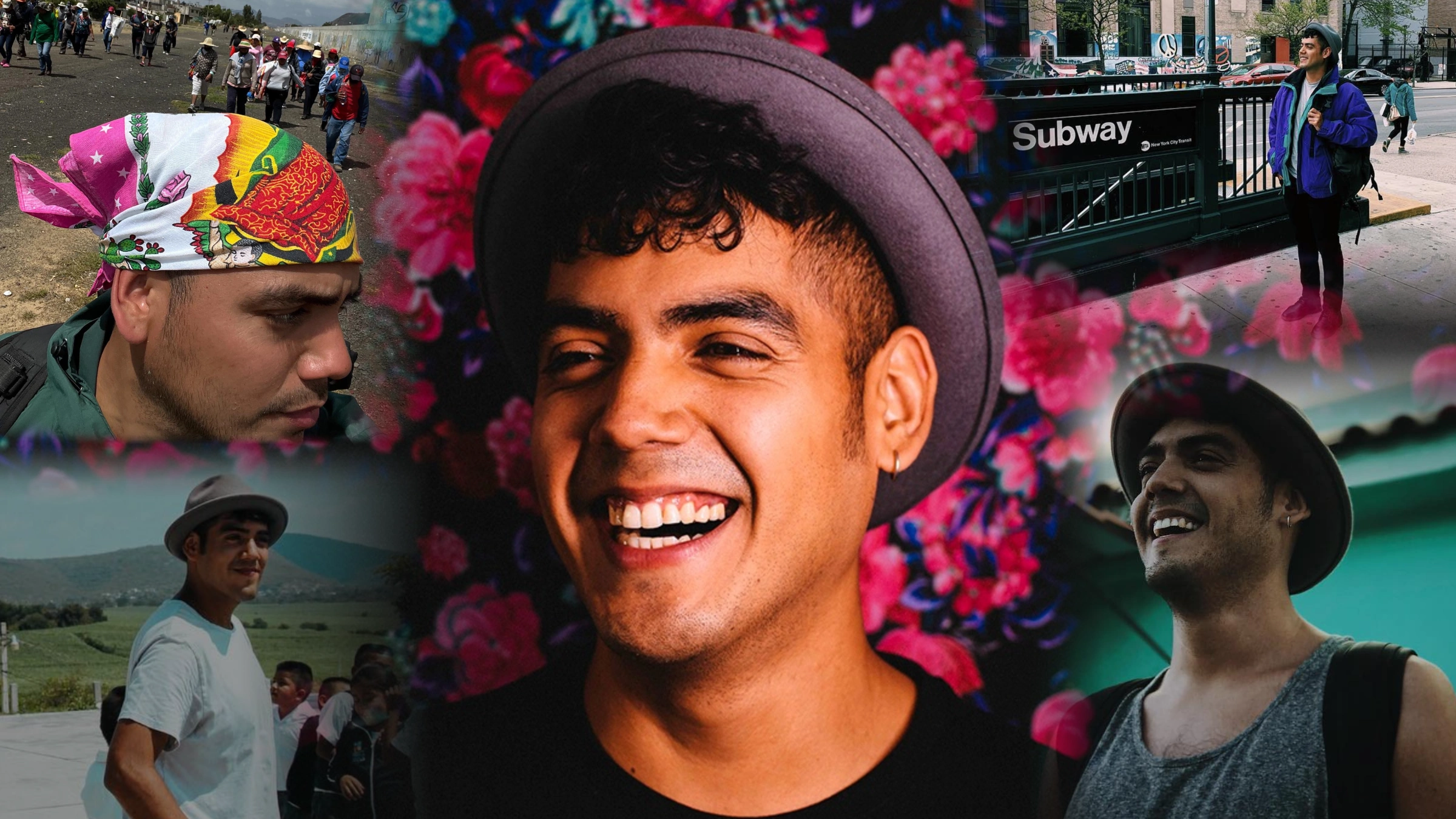
We should be able to recognize Indigenous people without first placing them in the past.
To speak of their ancestors, admire their textiles, celebrate what they have contributed, and then lose interest when the conversation turns to the people living now is a peculiar, painfully convenient form of recognition. What, exactly, are we honoring if our curiosity ends where their present begins?
On Indigenous Peoples’ Day, I want us to spend some time there. A photograph helps us commemorate their lives and remember that they are still unfolding. Their stories deserve our attention today, too.
Saul Flores’s work offers one place to begin. The Mexican-Salvadoran photographer, writer, documentary storyteller, and public speaker, known online as sweetlikesaul, has documented migration, the sugar-producing community where his mother grew up, and Indigenous communities in Mexico through a project called Skin of the Natives.
That last body of work deserves a place near the beginning of his story.
Indigenous lives in the present
In September 2015, Flores published “Skin of the Zapatistas,” a photo essay from Chiapas that identifies images made at Caracol II. The accompanying writing explicitly names Tzotsil, Tzeltal, and Tojolabal peoples and situates the work within Skin of the Natives, his project documenting Indigenous communities in Mexico.
The names matter. Indigenous is not a substitute for learning who people are. Neither is Latino. We can become so comfortable speaking of our collective diversity that we never get around to becoming familiar with the people it supposedly includes.
His essay’s captions move through family life, community gathering, and education. Read together, I see an invitation to consider a community beyond the single image of resistance through which an outside audience might recognize it.
I find care in that choice of subjects: families, children, people learning and gathering. These are lives being made together. Flores’s photographs and writing invite us to become interested in them, to learn something, to stay with people whose stories we might otherwise have passed by. That is a beautiful use of a talent.
In 2016, the Mint Museum announced that Flores and spoken-word artist Herrison Chicas would present the documentary Skin of the Natives: The Meaning of Life at the Con A de Arte celebration and a related library event.
His photographs give people room to be more than the hardship attached to their stories: to work, laugh, believe, and belong. A photograph can bring somebody closer to us, but the people in it still get to be more than what we understand about them. Their history belongs to them. So does the right to keep making it.
That responsibility follows us into the rest of Flores’s work.
The distance between us
In 2010, while he was a student at North Carolina State University, Flores undertook the project that became The Walk of the Immigrants. He traveled through ten countries, from Ecuador through Mexico toward the United States, on a journey he put at 5,328 miles. He walked, hitchhiked, and traveled by canoe. Along the way, he made more than 20,000 photographs. NC State later exhibited work from the trip.
To set out across ten countries with a camera required a willingness to leave the familiar and keep going. I admire that courage. Flores brought an artist’s attention to the journey, making photographs that allow us to encounter the people and places along it.
Flores’s own account leads us toward his mother. Her migration had given him access to educational opportunities. Returning to Atencingo made the unequal distribution of those opportunities painfully clear to him, and he wanted the photographs to help support a school there.
That is a familiar tension for those of us whose lives stretch across countries: knowing that what became possible for us remains unnecessarily difficult for people we love. A different address doesn’t resolve it. Sometimes it makes the distance more difficult to bear.
Flores was a U.S. citizen making a journey he chose, a distinction that matters when we talk about the migrants whose experiences he sought to understand. I admire his willingness to use that freedom, along with his education and talent, to make work that brings us closer to other people’s lives.
He carried a Nikon D80 and a single 50mm lens, choosing equipment that was light and inexpensive. In an early portrait reproduced alongside his Pictureline interview, a smiling face nearly fills the frame. Gray hair escapes beneath a brilliant red headwrap; strands of beads fall across a vividly colored garment. The closeness leaves little room for our attention to wander.
There is pleasure in that photograph, in its color and closeness, in the smile that meets us. I want us to have room for that. Joy belongs in the record of our communities, too. Flores’s eye gives it a place, and we get to encounter a person enjoying a moment, with a whole life of their own. The pleasure of looking, of recognizing something human in a stranger, is part of what his art offers.
Returning to Atencingo
From the Indigenous communities documented in Chiapas, another part of Flores’s work takes us to Atencingo, his mother’s community. Sugarland turns toward the people behind a product many of us encounter every day. We can tell you how we like our coffee and how much sugar to put in it; ask us about the people who cut the cane and the conversation becomes considerably less elaborate.
Somewhere between their labor and our consumption, an entire life gets misplaced. In a 2021 interview, Flores described a six-image, black-and-white series centered on Atencingo’s sugarcane cutters, the cortadores. He explained the choice of monochrome in terms of dignity and a sense of time extending beyond the immediate moment. He also spoke about religious devotion and pilgrimage to the Basilica of Our Lady of Guadalupe.
The faith matters. So does the life beyond the job. A person can spend much of a day cutting cane and still have a world that cannot be adequately explained by the cutting of it.
We can admire the cutters’ strength and still ask what their labor costs them, who profits from it, and what they want for themselves. Looking closely should make us more curious about all of that. Their endurance deserves recognition; their exhaustion deserves our concern.
The black-and-white treatment is an artistic choice Flores explains through dignity and time. I read that choice alongside the religious life he describes: an invitation to consider the people in the series with the seriousness and tenderness their lives deserve.
Flores’s description of Sugarland on his website also brings mothers and daughters into the story through an annual pilgrimage. That widens the attention beyond the cane fields to the women carrying family and communal responsibilities of their own. They deserve that space. How often do we praise a community’s perseverance while leaving the people holding it together somewhere in the background?
This is where a project like Sugarland can keep opening up. Labor leads us to family. Family leads us to faith, to memory, to the obligations people inherit and the ones they choose. We begin with an industry and find ourselves having to reckon with lives.
What the photograph carries back
His work also travels into classrooms and auditoriums. According to his official biography, Flores’s speaking and educational programs have reached more than 300 college and university campuses. The photographs become part of a larger conversation about migration, community, and the responsibilities we carry toward one another.
That belongs in the story, too. Representation includes who gets invited to teach, whose experiences are treated as knowledge, and who students encounter as someone worth listening to. His photography already gives us so much to consider. His writing, documentary work, and speaking offer other ways into the stories.
Who gets to document us matters, too. I value seeing a Latino artist bring his family’s history and his relationship to Atencingo into his work, while his photographs and writing from Chiapas introduce us to communities by name. In these projects, I see people working, laughing, believing, raising children, making lives together. People with something to tell us and futures of their own. That is what draws me to his work: the humanity he makes room for, and the invitation to recognize it in one another.
The relationship to Atencingo continued beyond those early images. In February 2023, NC State reported that Flores had recently launched MAMA Sugar, an artisanal sugar business connected to the community and named in honor of his mother. The same report traced the school project’s outcome to attention that helped persuade regional authorities to keep the school open and fund renovations.
That outcome for the school is one part of this story. So are the photographs themselves: the skill, imagination, and feeling with which Flores brings us into contact with other lives. I find inspiration in that range, in someone returning to the community his mother came from and finding different ways to honor it. There is room to create something beautiful and remain invested in the people it holds.
And what do we do with that inspiration? Spend time with the work. Look at how a face is framed, what a caption teaches us, what changes when we encounter a familiar subject through someone else’s eyes. Let ourselves be moved, and let that feeling make us curious.
Flores’s example makes me think about what we choose to do with our abilities. A camera, a page, a room full of students: each offers a way to share what we have come to understand. There is courage in putting that understanding before other people, and care in remaining willing to learn from them.
This is part of what I want LUCIR to make room for. Latino Unity for Culture, Inclusion & Representation means paying attention to the people who create, preserve, and expand our understanding of one another. Flores’s work takes us to Indigenous communities in Chiapas, to Atencingo, and along migrant journeys. Those are distinct stories. Our interest in them should be as expansive as our idea of community.
On Indigenous Peoples’ Day, his photographs give us a beautiful way to commemorate living people, to learn their histories and become more attentive to their present. We can honor the artist who made them while listening to the people whose lives they hold, including their own accounts of what they want for the generations coming after them.
The color and closeness of a portrait, the dignity he seeks in black and white, his attention to family and faith: there is so much to appreciate in how Saul sees and creates. His photographs deserve our admiration, and his courage and care deserve to be celebrated alongside them.
We need more people like him. Spend some time with Saul’s work.
Thank you, Saul, for the beauty you create, the stories you share, and the many ways you help us see and appreciate one another.
Thank you, Saul, for the beauty of your work and the humanity you express.
May you and the Indigenous communities you document forever be blessed.